


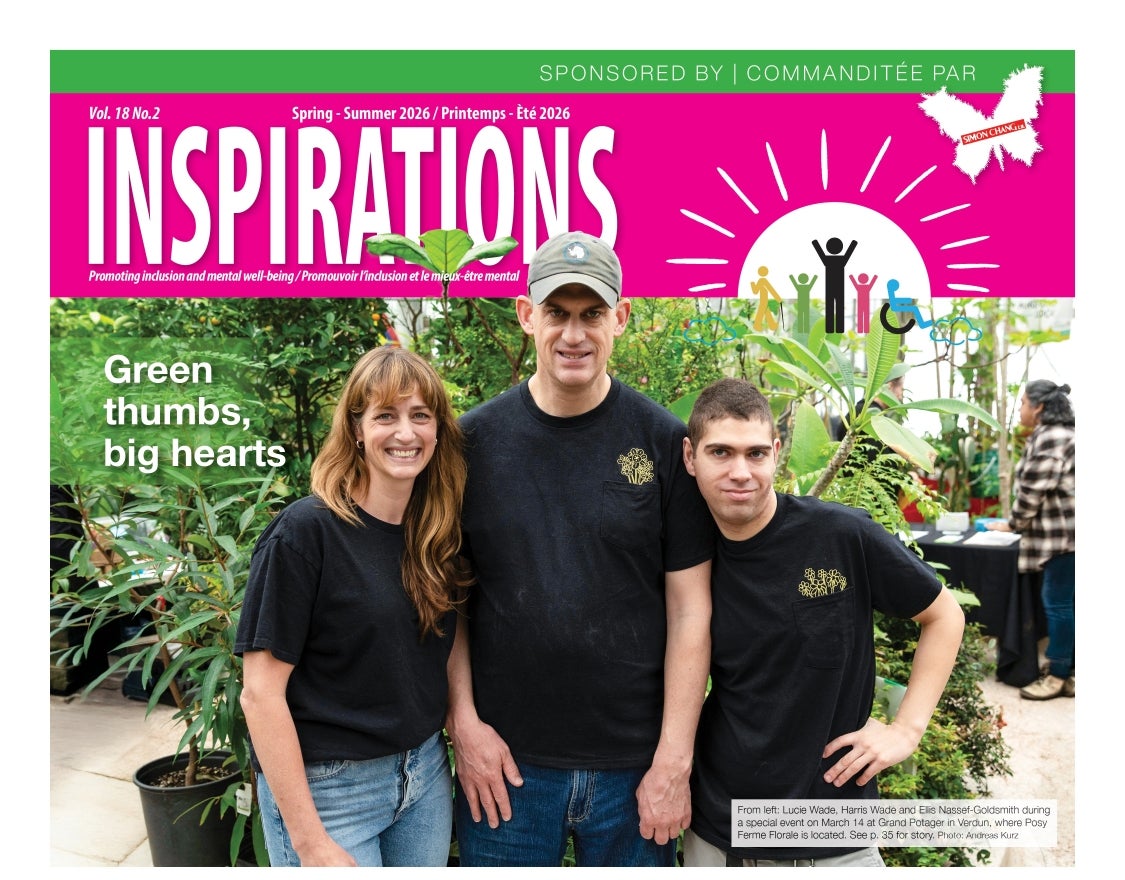
The most recent publication of Inspirations newspaper has these interesting articles.
By Wendy Singer
Chantal Petitclerc is the most celebrated track athlete in history, having won gold medals at the Olympics, Paralympics, and Commonwealth games. She recently addressed 350 EMSB students at Adult Learners Week – Proud to Learn 2011, sharing her story with great poise, and softness merged with a magnificent force of strength.
Petitclerc lost the use of her legs following an accident that occurred in an abandoned barn while on summer vacation. Only 13 years old at the time, she was left with a broken spinal cord, and the realization that her life would never be the same due to this life-altering moment.
This future star had no choice but to adapt quickly. “I learned that in a situation where you lose control over everything, the only control you have left is over your attitude and your emotions,” she recalled. “We don’t choose everything that happens to us, but we always choose how we are going to react to it.”
By Wendy Singer
The Stade Uniprix was bustling with activity on the morning of June 19th, 2011. Over 1,500 people came out for the inaugural Montreal Walk Now for Autism Speaks Canada. Participants, including families affected by autism, friends, teacher, therapists, and corporate partners raised awareness and funds.
A unique FUNdraising event, the morning was organized so that kids with autism could just be kids, and families could enjoy the community event.
Walk Now for Autism Speaks is sponsored by Toys “R” Us and Babies “R” Us, and holds events in over 80 cities across North America including five Canadian cities. MEGA Brands was a special sponsor for the Montreal event. These companies kept children busy with activities galore, from entertaining mascots to face painting, and an array of creative toys, which play a significant role in the development of children with autism through the promotion of physical skills, imagination and socialization.
Read more
Jean-Marc Généreux is a ballroom dance champion, a world renowned choreographer, a judge on CTV’s So You Think You Can Dance Canada, and a father of a child with special needs. This is the Généreux family’s story of inspiration and love.
Upon meeting Francesca Généreux, her clear blue eyes pierce right through you; curiosity, strength, and innocence pour out of them. She is tiny for a 12 year old, but that is the nature of her condition. Francesca has Rett Syndrome a rare neurological condition that almost exclusively affects girls. Physical features include small hands and feet and a deceleration of the rate of head growth. Repetitive hand movements, such as wringing and putting hands into the mouth are common. These girls typically have limited verbal skills and are often not ambulatory. The diagnostic and statistical manual of mental disorders, 4th revision (DSM-IV-TR) classifies Rett Syndrome under the category of Pervasive Developmental Disorders*. Francesca also suffers from seizures related to the condition.
Please read more of Tania Piperni's article in this pdf version of the
Inspirations newspaper - page 1.
Being a productive member of society with a disability, especially a physical one, has never been easier. I know that sounds cliché, but from a historical point of view it’s fairly accurate. The societal perception of an individual with a disability has changed dramatically in the past 500, 100, 50, and even 20 years. Where the assumption used to be that a disability meant an inability to succeed, people with disabilities are now perceived as simply requiring additional support to reach their potential. That said, the responsibility still lies with the individual to make use of the resources available to succeed.
How does all this relate to self-perception? Well, self-perception within a society like ours tends to be heavily dependent on comparisons to family, friends, and peers. When we’re young there are certain things which help us to define our sense of selves, such as play, socialization, and competition. When we become teenagers we generally either want to fit in - or stand out - for calculated reasons. As adults we generally strive to select an area in which we excel and turn it into a career that can sustain an independent lifestyle, eventually leading to partnership and parenthood. For a properly socialized individual without a severe mental incapacitation, the stages of growth and maturity are typically similar to someone without any impairment. This can be daunting if they try to compare themselves to their peers on the standard dimensions as they may come up short some of the time, negatively affecting their self-perception.
Please read more of Jay Jones-Doyles' article in this pdf version of the
Inspirations newspaper - page 2
Headed to the Niagara Falls area this summer? Here is my first very important piece of advice. Take advantage of the strong Canadian dollar and spend some time on the US side of the border. Grand Island, located smack in between Buffalo and Niagara Falls, New York (www.niagara-usa.com), represents a good base. The Holiday Inn Grand Island Resort and Conference Centre (www.holiday-inn.com/grandislandny) has been our base on two occasions, most recently during the winter, and we simply loved this gorgeous 263 room property, located at 100 Whitehaven Road. We were lucky to get a reservation, selecting a comfortable Jacuzzi suite. This is a great year-round choice. In the winter, the fitness centre, large indoor pool and whirlpool are real bonuses.The property is ideal for business and leisure travel alike. Soon enough, the attractive outdoor pool will be in operation. There is also an onsite health and fitness center, a gift shop
and yes, for the business executive, secretarial services.
Please read more of Mike Cohens' article in this pdf version of the
Inspirations newspaper - page 22
Having a child with a severe disability – and learning about and accepting that disability in everyday life – takes a lot of courage and sacrifice for every member of the family involved. It also takes a lot of courage and sacrifice for a parent to embark upon a personal journey to find out more about the disability that affects their child and why it happens, as well as alternative means to make sure their child is properly looked after, in order to have a life filled with dignity and respect.
That was the case with Globe and Mail journalist Ian Brown, whose son Walker was born with a rare genetic mutation called Cardiofaciocutaneous (CFC) Syndrome. He chronicles life with Walker and his quest to discover what causes CFC Syndrome in his critically-acclaimed memoir The Boy in the Moon.
Please read more Stuart Nulman's article in this pdf version of the
Inspirations newspaper - page 9
Lorsque j’ai débuté mon poste au département des services aux élèves, en novembre dernier, j’ai eu le mandat d’écrire un article en français dans le journal « Inspirations ». Pour mon premier article, on m’a conseillé de vous écrire au sujet de mon cheminement et la raison de mon choix de carrière.
Il est certain que mon passage à la commission scolaire English Montréal fut un grand changement dans ma vie, puisque j’ai travaillé les vingt dernières années à la commission scolaire Riverside, ou je fus enseignante, orthopédagogue, conseillère pédagogique en adaptation scolaire et dernièrement, coordonnatrice des services complémentaires.
Depuis aussi longtemps que je puisse me souvenir, j’ai toujours eu le désir de travailler dans le monde de l’éducation, tout particulièrement, auprès des élèves ayant des besoins particuliers. J’ai débuté ma carrière à l’éducation des adultes dans un atelier protégé pour adultes ayant une déficience intellectuelle. Par la suite, lors de ma deuxième année dans le domaine, j’ai enseigné en alphabétisation. Ma formation ne m’avait pas vraiment préparée pour un tel poste; toutefois, je réalise aujourd’hui, que ce que j’y ai vécu était vraiment unique comme expérience de vie.
Please read more Julie René de Cotret's article in this pdf version of the
Inspirations newspaper - page 6
What could be better than having a full communication system available on a small, “cool” mobile device? Many children with autism spectrum disorders, communication disorders and developmental delays can now use mobile devices to help communicate in ways that they were never able to in the past.
Please read more Andrea Prupas' article in this pdf version of the
Inspirations newspaper - page 5